Tuesday, November 6, 2012

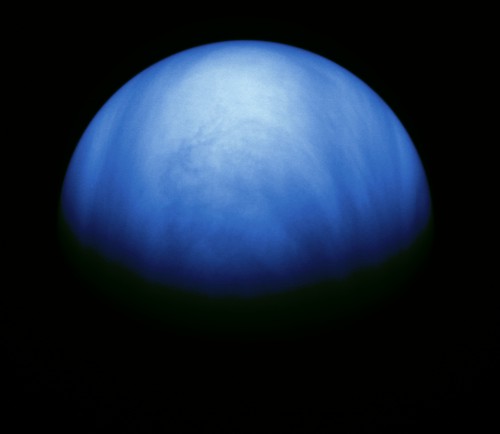
What about Venus?

NASA Photo
Mars is getting a lot of attention lately.  Truth be told, Mars has been getting a lot attention for quite some time: landers, rovers, orbiters, and Elon Musk and President Obama want to send people there.  Mars One is creating a reality TV show to send contestants to the surface of Mars!

So what about Earth's "sister" planet?  Where's the love for Venus?  [This question is all the more ironic given that in Roman mythology, Venus was the goddess of love, beauty, sex, and all that.]

Well, I am not going to sit idly and do nothing.  I'm going to start giving Venus more of the attention it sorely deserves!  Here are some of my reasons:
  • Venus is right there every night (well, most nights)!  It's the second-brightest object in the night sky, and its phases can be observed with binoculars.
  • It is the closest-approaching planet to Earth (38 million kilometers at its closest)
  • It is roughly the same size and mass as Earth
  • It has an honest-to-goodness atmosphere
  • It possesses the most similar environment to Earth conditions in the solar system1
  • It may have harbored life in its early days
I've been interested in Venus for quite some time, and have always wanted to dig a little deeper into the subject.  Be careful what you wish for!  I'm currently taking a UND grad course in Astrobiology, and our final assignment is to write a literature review on an astrobiological subject.  I chose Venus, so it's going to be all Venus, all the time for me.

I'll do what I can to share interesting snippets here on the blog as I go, but I also plan to write some topical articles such as:
  • Robotic Missions to Venus: Past, Present
  • Robotic Missions to Venus: Proposed
  • The Case for Human Missions to Venus
  • Venus Facts You Should Know
Check back, I'll try to keep the material coming every week or so for a while.


Footnotes
1. This is not at the surface... it is about 50km up into the Venusian atmosphere.

Friday, October 26, 2012

Pushing back my acquired attention deficit disorder


I've read a lot of articles lately (or at least I've seen their headlines) lamenting the fragmented way many people now consume information.  It seems everyone who is "connected" via social media splinters their time so much that they are unable to do a deep dive on anything, failing to learn something beyond a soundbite of information.

I have personal experience with this problem.  A few years ago, I discovered RSS, and began constructing an intimidating list of bloggers and journalists that I wanted to follow.  Like everyone else, I was unable to keep up.  The number of back-logged readings grew to the point that I was incapable of clicking on my favorite feeds because I knew I could not possibly read through even a small fraction of the hundreds of  articles still marked as "unread."

More recently, I created a twitter account and began following three or four hundred astronomers, space program writers, and space enthusiasts.  Of course, unless you sit with a Twitter window open and continuously scan these tasty morsels, you're gonna miss something.  And when I do follow a link to an interesting bit of longer-form writing, I don't have the time to read it.  Off it goes to my Instapaper account, where it sits forever unread (for much the same reason).

There was a time when I blogged.  And I mean I really did blog-- my weekly recaps of my lunches with my friend George were long, painstakingly researched, and always fun to return to later.  I also blogged about my journey as an archaeology student, and these were sometimes pretty lengthy posts.

What is the state of my writing now?  The metaphorical fields of my blogs lie fallow, and all I make time for is tweeting (or re-tweeting) interesting original work by others, much of which I have not read in its entirety (see earlier remarks).  Not only am I no longer capable of dedicating time to reading longer works, I'm also unable to dedicate time to creating anything exceeding a sentence in length.

The internet and social media have created attention-deficit symptoms that I never experienced before, a malady I've come to believe might only be cured by a 28-day program that excludes all information sources, save possibly a daily newspaper.

I feel I might also benefit from a similar approach with regard to writing: Allow myself to only create written work that exceeds some arbitrary word count significantly longer than a tweet or a Facebook post.  Naturally I want to be clever about it, so I set about picking a number that tied to some familiar idea, and that was very Mama Bear-like in size.  The very familiar adage "a picture is worth a thousand words" appealed to me, but 1000 seemed too long... so I decided to name my series of writings "Worth half a picture."

There's no way I can write 500 words every day (certainly not on topics that are interesting to anyone), so these will be a weekly effort.  Let's see where it goes.

Friday, December 16, 2011

It's Been a Big Week for Commercial Space

Just to recap the news from Commercial Space in the last week:

  • SpaceX gets approval to combine their COTS demonstration flights 2 and 3 into a single flight, and a firm launch date of February 7, 2011.  We're only eight weeks away from the first commercial delivery of supplies to the ISS!
  • StratoLaunch announces their plans to build an air-launched solution for placing payloads of up to 13,500 kg in LEO.  Scaled Composites will create the world's largest airplane to carry a SpaceX Falcom 9 derivative to 30,000 feet where the rocket will be launched to orbit.
  • NASA announces they will be using Space Act Agreements, rather than FAR-based contracts for the third phase of the Commercial Crew Development program.
  • Orbital Sciences announced that its new launcher (also part of the COTS program), formerly known as the Taurus II, has been renamed the Antares.

CCDev3: The Glass is Half Full

NASA has made lemonade out of the lemons Congress gave them (Commercial Crew gets only $406 million in the coming year).  Dropping the idea of Firm Fixed-Price contracts under the Federal Acquisition Regulations (FARs) and choosing instead to continue phase 3 of the CCDev using Space Act Agreements (SAAs) will allow NASA to remain engaged with multiple suppliers and keep costs down for those suppliers.

The largest concerns and complaints being aired by members of congress and the press generally involve how much control NASA will lose.  Many people are picking up on comments from NASA's Bill Gerstenmaier that while the SAA approach will provide more flexibility, it "doesn't insure that we're going to get exactly what we need coming out the other side".

How can anyone believe that the suppliers vying for the ultimate contracts to deliver NASA astronauts to LEO are not completely aware of what NASA needs?  After two rounds of CCDev work, they know precisely what is required.  And if for some reason one of these companies does not produce a solution that satisfies NASA in the end, NASA will not be contracting for their services.

Continuing CCDev under SAAs is the best news we've had in months, and it in no way threatens NASA getting their requirements met.

Friday, September 16, 2011

Has Russia Been Blocking Dragon Docking At The ISS?

Russian Comments on SpaceX Flight

A news report surfaced at the Ria Novosti site with the headline "Private U.S. capsule not to dock with ISS".  Just as with U.S. media outlets, the substance of the article was not nearly as definitive as the attention-grabbing headlines.

photo SpaceX
A short time later, NASA announced via twitter that the story was incorrect, and that no decision had yet been made regarding the SpaceX test flight slated for later this year.

The Russian news story tries to connect the dots between old news and recent comments from Vladimir Solovyov, head of the Russian segment of the ISS mission control.  He did state that "a flight by the Dragon to the ISS, but without berthing, has tentatively been scheduled for the end of this year. Though, I do not know, whether it'll fly or not," which was true even before the failed Progress launch on August 24th (NASA has only officially approved two separate flights for the Dragon to the ISS, one to rendezvous, the second to actually dock.  Approval for combining the two flights has been pending for some time).

What jumps out of this story are the comments that are behind the headline, indicating that Russia will not allow the SpaceX vehicle to dock with the ISS unless its safety is fully tested:

"We will not issue docking permission unless the necessary level of reliability and safety is proven," said Alexei Krasov, head of the human spaceflight department of Roscosmos. "So far we have no proof that this spacecraft duly comply with the accepted norms of spaceflight safety."

If anyone has been wondering what was taking NASA so long to grant formal approval to a combination of the COTS-2 and COTS-3 flights, I think we have our answer: Russia is not convinced the Dragon is not a threat to the safety of their personnel on the ISS. In light of the current crew situation aboard the ISS and the delayed arrival of astronauts trained to deal with the Dragon, what might be SpaceX's best course?  I would like to see the Falcon 9/Dragon launch go forward on November 30th, and do so as the scheduled COTS-2 flight (i.e., NOT dock with the ISS).  Doubts about the Falcon 9 following the engine anomaly which occurred during its last test flight could be put to rest with an extra flight, and the COTS-3 flight could proceed early next year once the ISS is fully crewed with the right personnel.

Obviously the cost for two flights is at least double that of a combined flight, but the additional experience would be valuable for SpaceX.

Wednesday, September 14, 2011

NASA Awards $3 Million to Further Research in Solar Electric Propulsion

NASA today announced awards totaling about $3 million to five companies to "develop concepts for demonstrating solar electric propulsion in space."  Each of these companies is expected to produce a report intended to contribute to a mission concept to demonstrate solar electric propulsion technologies.  NASA expects that such propulsion systems will be a part of effective payload delivery to high Earth orbits and beyond.

These awards are part of the first of four Point of Departure (POD) missions from NASA's Flagship Technology Demonstration (FTD) Program, and are the result of proposals submitted in response to a Broad Agency Announcement issued on June 17th.  The mission is intended to show that Solar Electric  Propulsion (SEP) technology could reduce Earth-Mars transit time from months to weeks.

The other three POD missions are:
  • On-orbit storage and transfer of cryogenic fuels (2015)
  • Inflatable habitat module attached to ISS (2016)
  • Use of aerocapture to land large payloads on Mars (2018)
More in-depth information on the FTD Program can be found at Hobby Space.

Let's take a closer look at the first of these companies selected for the concept phase of the first mission (follow-on posts will cover the other award recipients).


Analytical Mechanics Associates Inc., in Hampton, Va.

AMA has worked on commercial and government projects since 1962, providing engineering consulting and services.  In addition to being selected for this mission, they were also selected to participate in the concept phase of the cryogen fuel storage and transfer mission in August of this year.

They are keeping their work on SEP close to the vest, with the exception of a couple of intriguing videos.  The first video is an animation showing a SEP- driven spacecraft heading away from Earth toward the Moon, and the second depicts the SEP Stack arriving at a near-Earth asteroid.

AMA's bread and butter looks to be the development of anaylsis, studies, and recommendations to primarily space-related customers, so this work is righht up their alley.

The State of Heavy Lifting

With NASA's commitment today  to a design for their new Heavy Lift Vehicle (HLV), it seems like a good time to review the current state of heavy lift capability and development.

If you wanted to get a large payload to Low Earth Orbit (LEO) today, what are your HLV options?

United Launch Alliance (ULA) provides the Delta IV Heavy, which is capable of placing nearly 23 metric tons (mT) in LEO.  The Titan IV-B can lift 21 mT, Russia's Proton M flings 21 metric tons to LEO, and the Ariane 5 ES can deliver 20 mT.  Japan offers the H-IIB, which can place 19 metric tons in LEO, and China's Long March 3B has a maximum LEO payload of 13 mT.

On the near horizon, here are the likely new heavy launch options:

  • China's Long March 5 (CZ-5) family of launchers will sport a maximum capacity to LEO of 25 mT, with an initial test launch date sometime in 2014.
  • SpaceX's Falcon Heavy will carry 53 mT to LEO, and their manifest says they plan their first launch at Vandenberg in 2012.
  • NASA's SLS will initially provide 70 metric tons of payload to LEO, with the first development launches "targeted for late 2017."
While everyone is getting excited about NASA's new Space Launch System and its promised ability to carry humans to the asteroid belt and Mars, let's keep some perspective.  NASA estimates that getting the new launcher and the Orion spacecraft ready for an initial development 2017 launch is going to cost U.S. taxpayers between $17 billion and $22 billion.  And if they are already aiming for a late 2017 date, anyone in the aerospace industry knows that means 2018 for sure.

SpaceX, on the other hand, plans to have their Falcon Heavy ready for its first test flight in late 2012, a full five years earlier.  Oh, and SpaceX is already advertising launch prices in the $80-125 million range.  That's "million," not "billion."

So why are we gutting the rest of NASA's dwindling budget to fund the SLS?