Saturday, November 1, 2014

It's About (Avoiding) Writing

I have a report due this Friday, I have a conference abstract due on Thursday, and I've been neglecting my Venus blog.  Oh, I've also floated the idea with two colleagues of submitting some work we did for publication, and that has sat with no action now for a couple of months.

What time is it?  It's Writing Time.  And at just the perfect moment, it also is the first day of Academic Writing Month 2014!  I signed up, of course, because I'd rather have a little fun tweeting and blogging about writing, instead of ACTUALLY WRITING.

Okay, I've had my bit of fun, so I better get to it.  Wait-- I need a plan!  I guess I can avoid real writing for a few more minutes by jotting down a few notes about how I might succeed.

First Things First

The 5-page report on Computing and Communications for my PicoSat Design course is a major part of my grade, and the deadline (this coming Friday) is pretty much carved in stone... so this needs to happen first.

Of course, the conference abstract is due even sooner, so IF it is going to happen, it needs to happen soon.  I'll need some input from other members of the team at UND.

The paper on asteroid mission alternatives already exists, but needs to be improved substantially before it is fit for publication submittal.  There are a number of steps to this, but the first is incorporating several comments from our professor.  This is the best candidate for AcWriMo motivation, because no one is making me do it!  If it doesn't get done, no harm done.  But if I can push it forward, I will never regret it.  Nevertheless, I can't even think about it until the other two items are written.

Due Dates

Here's when things need to be done:

November 6: AstroRecon Conference Poster Abstract
November 7: SES 598 Computer/Software Report
November 12: Venus Dispatches post
November 19: Venus Dispatches post
November 26: Venus Dispatches post
November 30: Asteroid Characterization Mission draft ready to submit


The Plan


  1. Keep the objectives posted where I can see them.
  2. Break the work down into manageable parts.
  3. Blog or tweet my accomplishments each day.
  4. Note my accomplishments in the AcWriMo spreadsheet.
  5. WRITE EVERY DAY.


Sunday, November 17, 2013

Setting my alarm for 2021.

2021. Eight years from now.  If NASA can keep it on schedule, that's when the first human crew will be launched into space aboard NASA's Space Launch System (SLS) Block I launch vehicle.  The mission will essentially be a repeat of Apollo 8, whose capsule and crew orbited the Moon and returned to Earth in December of 1968 (a mere seven years after the first successful Mercury launch).

NASA formally announced the SLS in September of 2011, so they've already had two years to work on it... meaning a full decade from concept to launch.  And remember: it is based on mostly off-the-shelf technology.

Why should I be excited about the SLS?  Sure, if it were here today, we could launch people and equipment into Lunar orbit and beyond.  But eight more years? And that assumes no slips in the schedule.  We know how often that happens.  We are more likely to not see humans flying the SLS until 2023, if it hasn't been canceled.

In the meantime, the Dragon and the Falcon family of launchers will be human-rated (and possibly joined by launchers/spacecraft from other commercial suppliers).  And while SpaceX is busy ferrying people and supplies to the ISS on NASA's nickel, Elon Musk will be working toward loftier goals.  The next few years will be exciting times for space exploration, but other than an un-crewed test flight four years from now, the SLS will not play much of a part.

1st-graders filled with enthusiasm for the mighty SLS by NASA's educational and public outreach efforts?  They'll be paying speeding tickets before they will see a meaningful launch.

So I'm going to set an alarm for 2021, and then I'll consider getting excited about the SLS.

Sunday, December 30, 2012

A newly discovered magnetic state for the Venusian ionosphere

We have known since 1962 (thanks to Mariner II) that Venus does not possess a magnetic field of its own (Sonett 1963).  In the late 1970's, the Pioneer Venus Orbiter's magnetometer detected large-scale, steady magnetic fields in the Venusian ionosphere  during solar maximum, when the solar wind dynamic pressure was great enough to overcome the ionosphere's thermal pressure.  These magnetic fields are mainly oriented horizontally, and often exceed 100 gammas (Luhmann et al. 1980).

Even when the ionosphere was not dominated by the solar wind, the Pioneer craft detected small-scale magnetic features interpreted as flux ropes, structures that resemble a helix of woven magnetic fields, not unlike a rope.  This led researchers to conclude that the ionosphere's magnetic state could be categorized in two forms: magnetized, and unmagnetized with some small-scale flux ropes (Luhmann et al. 1980).

A recent publication aims to change this long-standing picture of the Venusian ionosphere, as a result of observations made by the Venus Express spacecraft since its orbit was modified such that it now reaches periapsis at a latitude of 90 degrees (over the North pole) and a height above Venus of only 170 km (well into the ionosphere).

T. L. Zhang and colleagues (2012) report that during solar minimum, Venus Express observed "giant flux ropes" embedded within a magnetized ionosphere.  They determined these woven structures to be on the order of 100 kilometers in diameter, 10 times the size of the flux ropes detected by Pioneer in an unmagentized ionosphere.  The magnetic flux contained within the giants ropes measures near 1000 Webers, much greater than the 2 to 3 Weber fluxes in the small ropes.

It is notable that in over 100 orbits when the Venus Express magnetometer detected these enhanced magnetic strength structures, they detected only one such giant rope during passage through periapsis. In addition, while the giant rope structure is seen as a single event by Venus Express only near 90 degrees latitude, the small flux ropes observed by Pioneer occurred throughout the dayside atmosphere.

These researchers propose that the Venusian ionosphere has a third known state, in addition to the two mentioned above (Zhang et al. 2012).  The possible states are:
  • Magnetized (during solar maximum and high solar wind pressure)
  • Unmagnetized with small-scale flux ropes (during solar minimum)
  • Magnetized with embedded giant flux ropes (during solar minimum)
And what do they believe is the cause of these large-scale magnetic helixes?  It remains "unknown and speculative."

It is interesting that Venus is not the only rocky planetary body in our solar system to display magnetic flux ropes.  The Mars Global Surveyor spacecraft has detected flux ropes in the ionosphere of Mars, and Cassini has detected twisted magnetic fields in the lower ionosphere of Titan that resemble the flux ropes observed on Venus and Mars (Wei et al. 2010).


REFERENCES:


Luhmann, J., Elphic, R., Russell, C., Mihalov, J., & Wolfe, J. (1980). Observations of large scale steady magnetic fields in the dayside venus ionosphere. Geophysical Research Letters, 7, 917-920. (pdf)

Sonett, C. P. (1963). A summary review of the scientific findings of the mariner venus mission. Space Science Reviews, 2(6), 751-777.

Wei, H., Russell, C., Zhang, T., & Dougherty, M. (2010). Comparison study of magnetic flux ropes in the ionospheres of venus, mars and titan. Icarus, 206(1), 174-181. (pdf)

Zhang, T., Baumjohann, W., Teh, W., Nakamura, R., Russell, C., Luhmann, J., . . . Du, A. (2012). Giant flux ropes observed in the magnetized ionosphere at venus. Geophysical Research Letters, 39(23), L23103.


Thursday, December 20, 2012

Venus Upper Atmosphere Workshop on January 24

UPDATED: Details now available for remote attendees.

Are you a planetary scientist studying the Venusian atmosphere, or an engineer looking to build spacecraft or instrumentation that will further the study of our twin planet?  Then clear your calendar on January 24th, 2013.

NASA's Glenn Research Center, along with the Ohio Aerospace Institute, is sponsoring a Science and Technical Interchange Meeting (STIM) on the topic of Venus Upper Atmosphere Investigations.

The aim of this day-long set of meetings is to encourage the discussion of shared goals and priorities with regard to the study of the atmosphere of Venus by spacecraft.

According to the agenda, they hope to
  1. Foster a science discussion on goals, objectives, priorities, and significance of the Venus upper atmosphere and how Venus upper atmosphere science would contribute to overall exploration of Venus,
  2. discuss the desired measurements and measurement requirements to achieve potential Venus upper atmosphere science, and 
  3. discuss spacecraft concepts and technologies that could reach the Venus UA and collect and return the desired data.
If you cannot attend in person, they may be making arrangements for attending remotely-- I have a question out to one of the organizers and I'll update this post accordingly.

If you are lucky enough to be able to travel to the workshop and can arrive a day early, they are planning a tour of the nearly-completed NASA Glenn Extreme Environments Rig (GEER) on the afternoon of the 23rd. Once completed, the GEER will be able to accurately simulate any planetary environment in the solar system, including both the surface and the atmosphere of Venus. Read more about the GRC's Strategic Science work here.

If you are interested in attending, registration is required.

Thursday, November 29, 2012

First to Venus: Mariner II

While one Soviet Venera spacecraft certainly passed near Venus prior to August of 1962, it was not successful in transmitting any data back to Earth... so Mariner II gets the credit for being the first successful probe to visit Venus.

Launched on August 27, 1962, Mariner II carried the following experiments intended for use at Venus (other instruments also took measurements of interplanetary space while enroute):

  • Microwave radiometer - meant to determine the temperature of the planet's surface and details concerning the atmosphere.
  • Infrared radiometer - meant to determine the structure of the cloud layer, and temperature distributions at cloud altitudes.
  • Magnetometer - meant to detect Venus' magnetic field

Mariner II arrived at its encounter point on December 14, almost four months after launch.  Never intended to enter orbit or plunge into the Venusian clouds, the spacecraft began recording as much information as it could in the short time Venus would be in range (the spacecraft was moving at 6.743 km/s relative to Venus).  A special command from Earth placed Mariner II  in "encounter" mode, during which it transmitted all recorded data in real time.  It passe within 34,854 km, and seven hours later, Mariner II returned to cruise mode to continue on in a heliocentric orbit.  Communication was lost on January 3, 1963.

So what did we learn about Venus from Mariner II?
  • The 19-mm microwave radiometer indicated roughly equal temperatures on the light and dark sides of the planet:
    • dark side =  460° K
    • terminator = 570° K
    • light side =  400° K
  • Near Venus, there was no indication of a magnetic field or of appreciable change in the solar plasma flux or the charged particle flux.
  • The infrared radiometer measured atmospheric temperatures that are consistent with Earth-based observations (hovering around 230° K), and detected no significant difference between the light and dark sides of the planet.
  • Mass of Venus: 4.87 x 10^24 kg (0.81485 of Earth)
Mariner II was successful by any measure, and set the stage for continued exploration of the inner solar system.  It was followed to Venus by a number of probes from the U.S., the Soviet Union, and the European Space Agency.  More to come!


REFERENCES:

Chase, S.C.; Kaplan, L.D.; Neugebauer, G. (1963) "The Mariner 2 Infrared Radiometer Experiment, Journal of Geophysical Research 68 (22): 6157–6169. (http://ntrs.nasa.gov/archive/nasa/casi.ntrs.nasa.gov/19640006050_1964006050.pdf)

NASA, Mariner-Venus 1962: Final Project Report, NASA SP-59, Washington, 1965 (http://ntrs.nasa.gov/archive/nasa/casi.ntrs.nasa.gov/19660005413_1966005413.pdf)

National Space Science Data Center: Mariner II. NASA web site (http://nssdc.gsfc.nasa.gov/nmc/spacecraftDisplay.do?id=1962-041A)

Sonett, C. P. (1963). "A summary review of the scientific findings of the mariner venus mission." Space Science Reviews, 2(6), 751-777.

Thursday, November 15, 2012

Wandering Rogue Planet Is Really an Isolated Planetary Mass Object (IPMO)

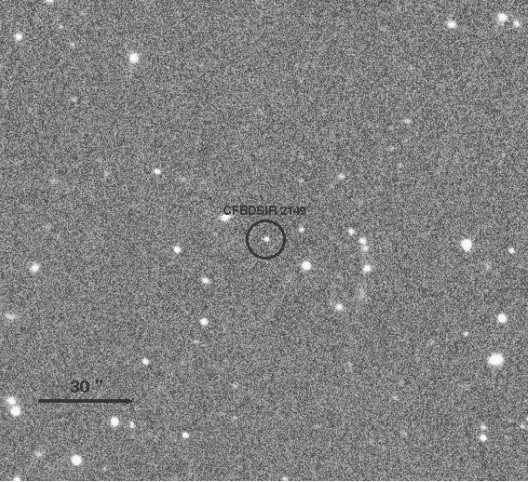
IPMO known as CFBDSIR2149
Earlier this week, news outlets and Twitter were abuzz with recent news of a "rogue" and "orphaned" planet detected "wandering" through space a mere 100 light years from us.  I found this kind of reporting somewhat misleading, since it conjured images of a planet that was somehow flung out of orbit around its parent star, now left all alone in the cold... wandering... and even though the BBC article did a pretty good job of conveying some of the scientific conclusions, they still used quotes from the study's authors that sensationalized the "homeless planet" idea.

Reading the research paper that announced the discovery, CFBDSIR2149-0403: a 4-7 Jupiter-mass free-floating planet inthe young moving group AB Doradus ?, I got a somewhat different impression.

Philippe Delorme and his colleagues begin their report by questioning the dividing line between planets and star-like objects.  Currently, the Astronomical Union defines a planetary mass as one falling below the necessary minimum for thermonuclear fusion of deuterium (roughly 13 Jupiter masses), with brown dwarfs and stars above that line.  And while this new object weighs in far below that mass boundary and physically meets this criterion for a planet, there's more to the story.  It seems CFBDSIR2149 is tagging along with 30 or so young stars (similar in both age and composition) known as the AB Doradus Moving Group (ABDMG).  This association means it is likely about the same age and that it formed under similar circumstances.  For this reason, Delorme, et al. speculate that CFBDSIR2149 is an object resulting from stellar formation processes.  And even though its mass is insufficient to burn deuterium, it should not be classified as a planet.

What they think they know:  CFBDSIR2149 is a free-floating substellar object with a mass of 4-7 Jupiter masses, a surface tempurature of ~700K, and is likely a member of the AB Doradus group of stars that are between 50 ans 120 million years old.

Fun facts:
  • CFBDSIR stands for Canada-France Brown Dwarf Survey InfraRed
  • The authors find the probability that CFBDSIR2149 is a member of the ABDMG is 87%
  • They are continuing their parallax measurements of CFBDSIR2149 to confirm or deny its membership in the AB Doradus group (no doubt another paper will be forthcoming)


Tuesday, November 6, 2012

AcWriMo 2012 - My Commitment

Have you read about AcWriMo?  Yep, its a sort of National Novel Writing Month (NaNoWriMo) for academic writing.  I've decided to participate, and yes, I'm a little late to the game (It's already November 6).

This is where I make set a crazy goal: Complete a publishable (format and content, anyway) literature review of current thinking on astrobiological possibilities (past and present) for Venus by November 30.

Go Public: I just did with this blog post!

Strategy: Well, it's like writing anything, so there is a sequence for me:


  1. Collection: Find the published papers I will start with for the research.  This entails a lot of time with Google Scholar, RefWorks, and the SAO/NASA Astrophysics Data System.
  2. Reading.  just what it says, plus note-taking.
  3. Organization: Taking all of my notes and organizing them into the sections of the paper
  4. Writing.
There is a fair amount of rinse & repeat between steps 1 and 2, since good papers will lead me to others.  Even so, there is something to be written every day, almost from the beginning.

Discuss: I will.  I'll be posting here and on Twitter at @ElevenPointTwo.

What about Venus?

NASA Photo
Mars is getting a lot of attention lately.  Truth be told, Mars has been getting a lot attention for quite some time: landers, rovers, orbiters, and Elon Musk and President Obama want to send people there.  Mars One is creating a reality TV show to send contestants to the surface of Mars!

So what about Earth's "sister" planet?  Where's the love for Venus?  [This question is all the more ironic given that in Roman mythology, Venus was the goddess of love, beauty, sex, and all that.]

Well, I am not going to sit idly and do nothing.  I'm going to start giving Venus more of the attention it sorely deserves!  Here are some of my reasons:
  • Venus is right there every night (well, most nights)!  It's the second-brightest object in the night sky, and its phases can be observed with binoculars.
  • It is the closest-approaching planet to Earth (38 million kilometers at its closest)
  • It is roughly the same size and mass as Earth
  • It has an honest-to-goodness atmosphere
  • It possesses the most similar environment to Earth conditions in the solar system1
  • It may have harbored life in its early days
I've been interested in Venus for quite some time, and have always wanted to dig a little deeper into the subject.  Be careful what you wish for!  I'm currently taking a UND grad course in Astrobiology, and our final assignment is to write a literature review on an astrobiological subject.  I chose Venus, so it's going to be all Venus, all the time for me.

I'll do what I can to share interesting snippets here on the blog as I go, but I also plan to write some topical articles such as:
  • Robotic Missions to Venus: Past, Present
  • Robotic Missions to Venus: Proposed
  • The Case for Human Missions to Venus
  • Venus Facts You Should Know
Check back, I'll try to keep the material coming every week or so for a while.


Footnotes
1. This is not at the surface... it is about 50km up into the Venusian atmosphere.

Friday, October 26, 2012

Pushing back my acquired attention deficit disorder


I've read a lot of articles lately (or at least I've seen their headlines) lamenting the fragmented way many people now consume information.  It seems everyone who is "connected" via social media splinters their time so much that they are unable to do a deep dive on anything, failing to learn something beyond a soundbite of information.

I have personal experience with this problem.  A few years ago, I discovered RSS, and began constructing an intimidating list of bloggers and journalists that I wanted to follow.  Like everyone else, I was unable to keep up.  The number of back-logged readings grew to the point that I was incapable of clicking on my favorite feeds because I knew I could not possibly read through even a small fraction of the hundreds of  articles still marked as "unread."

More recently, I created a twitter account and began following three or four hundred astronomers, space program writers, and space enthusiasts.  Of course, unless you sit with a Twitter window open and continuously scan these tasty morsels, you're gonna miss something.  And when I do follow a link to an interesting bit of longer-form writing, I don't have the time to read it.  Off it goes to my Instapaper account, where it sits forever unread (for much the same reason).

There was a time when I blogged.  And I mean I really did blog-- my weekly recaps of my lunches with my friend George were long, painstakingly researched, and always fun to return to later.  I also blogged about my journey as an archaeology student, and these were sometimes pretty lengthy posts.

What is the state of my writing now?  The metaphorical fields of my blogs lie fallow, and all I make time for is tweeting (or re-tweeting) interesting original work by others, much of which I have not read in its entirety (see earlier remarks).  Not only am I no longer capable of dedicating time to reading longer works, I'm also unable to dedicate time to creating anything exceeding a sentence in length.

The internet and social media have created attention-deficit symptoms that I never experienced before, a malady I've come to believe might only be cured by a 28-day program that excludes all information sources, save possibly a daily newspaper.

I feel I might also benefit from a similar approach with regard to writing: Allow myself to only create written work that exceeds some arbitrary word count significantly longer than a tweet or a Facebook post.  Naturally I want to be clever about it, so I set about picking a number that tied to some familiar idea, and that was very Mama Bear-like in size.  The very familiar adage "a picture is worth a thousand words" appealed to me, but 1000 seemed too long... so I decided to name my series of writings "Worth half a picture."

There's no way I can write 500 words every day (certainly not on topics that are interesting to anyone), so these will be a weekly effort.  Let's see where it goes.

Friday, December 16, 2011

It's Been a Big Week for Commercial Space

Just to recap the news from Commercial Space in the last week:

  • SpaceX gets approval to combine their COTS demonstration flights 2 and 3 into a single flight, and a firm launch date of February 7, 2011.  We're only eight weeks away from the first commercial delivery of supplies to the ISS!
  • StratoLaunch announces their plans to build an air-launched solution for placing payloads of up to 13,500 kg in LEO.  Scaled Composites will create the world's largest airplane to carry a SpaceX Falcom 9 derivative to 30,000 feet where the rocket will be launched to orbit.
  • NASA announces they will be using Space Act Agreements, rather than FAR-based contracts for the third phase of the Commercial Crew Development program.
  • Orbital Sciences announced that its new launcher (also part of the COTS program), formerly known as the Taurus II, has been renamed the Antares.

CCDev3: The Glass is Half Full

NASA has made lemonade out of the lemons Congress gave them (Commercial Crew gets only $406 million in the coming year).  Dropping the idea of Firm Fixed-Price contracts under the Federal Acquisition Regulations (FARs) and choosing instead to continue phase 3 of the CCDev using Space Act Agreements (SAAs) will allow NASA to remain engaged with multiple suppliers and keep costs down for those suppliers.

The largest concerns and complaints being aired by members of congress and the press generally involve how much control NASA will lose.  Many people are picking up on comments from NASA's Bill Gerstenmaier that while the SAA approach will provide more flexibility, it "doesn't insure that we're going to get exactly what we need coming out the other side".

How can anyone believe that the suppliers vying for the ultimate contracts to deliver NASA astronauts to LEO are not completely aware of what NASA needs?  After two rounds of CCDev work, they know precisely what is required.  And if for some reason one of these companies does not produce a solution that satisfies NASA in the end, NASA will not be contracting for their services.

Continuing CCDev under SAAs is the best news we've had in months, and it in no way threatens NASA getting their requirements met.

Friday, September 16, 2011

Has Russia Been Blocking Dragon Docking At The ISS?

Russian Comments on SpaceX Flight

A news report surfaced at the Ria Novosti site with the headline "Private U.S. capsule not to dock with ISS".  Just as with U.S. media outlets, the substance of the article was not nearly as definitive as the attention-grabbing headlines.

photo SpaceX
A short time later, NASA announced via twitter that the story was incorrect, and that no decision had yet been made regarding the SpaceX test flight slated for later this year.

The Russian news story tries to connect the dots between old news and recent comments from Vladimir Solovyov, head of the Russian segment of the ISS mission control.  He did state that "a flight by the Dragon to the ISS, but without berthing, has tentatively been scheduled for the end of this year. Though, I do not know, whether it'll fly or not," which was true even before the failed Progress launch on August 24th (NASA has only officially approved two separate flights for the Dragon to the ISS, one to rendezvous, the second to actually dock.  Approval for combining the two flights has been pending for some time).

What jumps out of this story are the comments that are behind the headline, indicating that Russia will not allow the SpaceX vehicle to dock with the ISS unless its safety is fully tested:

"We will not issue docking permission unless the necessary level of reliability and safety is proven," said Alexei Krasov, head of the human spaceflight department of Roscosmos. "So far we have no proof that this spacecraft duly comply with the accepted norms of spaceflight safety."

If anyone has been wondering what was taking NASA so long to grant formal approval to a combination of the COTS-2 and COTS-3 flights, I think we have our answer: Russia is not convinced the Dragon is not a threat to the safety of their personnel on the ISS. In light of the current crew situation aboard the ISS and the delayed arrival of astronauts trained to deal with the Dragon, what might be SpaceX's best course?  I would like to see the Falcon 9/Dragon launch go forward on November 30th, and do so as the scheduled COTS-2 flight (i.e., NOT dock with the ISS).  Doubts about the Falcon 9 following the engine anomaly which occurred during its last test flight could be put to rest with an extra flight, and the COTS-3 flight could proceed early next year once the ISS is fully crewed with the right personnel.

Obviously the cost for two flights is at least double that of a combined flight, but the additional experience would be valuable for SpaceX.

Wednesday, September 14, 2011

NASA Awards $3 Million to Further Research in Solar Electric Propulsion

NASA today announced awards totaling about $3 million to five companies to "develop concepts for demonstrating solar electric propulsion in space."  Each of these companies is expected to produce a report intended to contribute to a mission concept to demonstrate solar electric propulsion technologies.  NASA expects that such propulsion systems will be a part of effective payload delivery to high Earth orbits and beyond.

These awards are part of the first of four Point of Departure (POD) missions from NASA's Flagship Technology Demonstration (FTD) Program, and are the result of proposals submitted in response to a Broad Agency Announcement issued on June 17th.  The mission is intended to show that Solar Electric  Propulsion (SEP) technology could reduce Earth-Mars transit time from months to weeks.

The other three POD missions are:
  • On-orbit storage and transfer of cryogenic fuels (2015)
  • Inflatable habitat module attached to ISS (2016)
  • Use of aerocapture to land large payloads on Mars (2018)
More in-depth information on the FTD Program can be found at Hobby Space.

Let's take a closer look at the first of these companies selected for the concept phase of the first mission (follow-on posts will cover the other award recipients).


Analytical Mechanics Associates Inc., in Hampton, Va.

AMA has worked on commercial and government projects since 1962, providing engineering consulting and services.  In addition to being selected for this mission, they were also selected to participate in the concept phase of the cryogen fuel storage and transfer mission in August of this year.

They are keeping their work on SEP close to the vest, with the exception of a couple of intriguing videos.  The first video is an animation showing a SEP- driven spacecraft heading away from Earth toward the Moon, and the second depicts the SEP Stack arriving at a near-Earth asteroid.

AMA's bread and butter looks to be the development of anaylsis, studies, and recommendations to primarily space-related customers, so this work is righht up their alley.

The State of Heavy Lifting

With NASA's commitment today  to a design for their new Heavy Lift Vehicle (HLV), it seems like a good time to review the current state of heavy lift capability and development.

If you wanted to get a large payload to Low Earth Orbit (LEO) today, what are your HLV options?

United Launch Alliance (ULA) provides the Delta IV Heavy, which is capable of placing nearly 23 metric tons (mT) in LEO.  The Titan IV-B can lift 21 mT, Russia's Proton M flings 21 metric tons to LEO, and the Ariane 5 ES can deliver 20 mT.  Japan offers the H-IIB, which can place 19 metric tons in LEO, and China's Long March 3B has a maximum LEO payload of 13 mT.

On the near horizon, here are the likely new heavy launch options:

  • China's Long March 5 (CZ-5) family of launchers will sport a maximum capacity to LEO of 25 mT, with an initial test launch date sometime in 2014.
  • SpaceX's Falcon Heavy will carry 53 mT to LEO, and their manifest says they plan their first launch at Vandenberg in 2012.
  • NASA's SLS will initially provide 70 metric tons of payload to LEO, with the first development launches "targeted for late 2017."
While everyone is getting excited about NASA's new Space Launch System and its promised ability to carry humans to the asteroid belt and Mars, let's keep some perspective.  NASA estimates that getting the new launcher and the Orion spacecraft ready for an initial development 2017 launch is going to cost U.S. taxpayers between $17 billion and $22 billion.  And if they are already aiming for a late 2017 date, anyone in the aerospace industry knows that means 2018 for sure.

SpaceX, on the other hand, plans to have their Falcon Heavy ready for its first test flight in late 2012, a full five years earlier.  Oh, and SpaceX is already advertising launch prices in the $80-125 million range.  That's "million," not "billion."

So why are we gutting the rest of NASA's dwindling budget to fund the SLS?

NASA Announces Space Launch System Configuration

NASA adminstrator Charles Bolden, in a joint press conference with Senators Hutchison and Nelson, announced the intended design for the new Space Launch System.

Highlights:

  • The configuration will consist of a core stage and an upper stage both powered by a liquid hydrogen and liquid oxygen propulsion system, and booster stages that will be open to competition.
  • The core stage will be powered by the RS-25D/E engines from the Space Shuttle, and the upper stage will be powered by the J-2X engine (a derivative design of the Saturn V main engines).
  • Solid Rocket boosters will initially be used for the booster stages during developmental flights, but the ultimate design of the booster stages will be determined as part of a competition.
  • The initial lift capacity is 70 metric tons to LEO, with later versions providing as much as 130 mT.  this is the most powerful U.S. launcher since the Saturn V (127 mT to LEO).
  • The first developmental flight is targeted for the end of 2017.
This modular architecture was chosen because it leverages existing capabilities, and its evolvable development approach allows the high-cost development activities occur early in the program.  Bolden stated that "the decision to go with the same fuel system for the core and the upper stage was based on a NASA analysis demonstrating that use of common components can reduce costs and increase flexibility."

NASA has already updated their websiste for the SLS, so more information is available there.

Tuesday, September 13, 2011

Next Progress Launch Scheduled for October 30th

Progress Freighter (photo ITAR-TASS)
ITAR-TASS reports the Russian space agency has announced a launch date of October 30th for their next Progress supply ship, bound for the ISS.

Assuming this flight is successful, they have scheduled the next manned Soyuz flight to the ISS for November 12, arriving in LEO only days before the remaining ISS crew of 3 will need to leave.  ISS Program Manager Mike Suffredini noted in late August that November 19th is the last possible date for de-manning the station.

Summary of NASA/ATK Commercial Crew Announcement

At 3:00pm EDT today, NASA and Alliant Techsystems (ATK) made a joint announcement regarding a possible acceleration of LEO crew transportation (see the Press Release here).

Ed Mango, NASA's Commercial Crew Program Manager, began his remarks by pointing out that Commercial Crew is making making steady progress, with development remaining on time, and on budget.  He then went to announce, as expected by many, that CC has entered into an unfunded Space Act Agreement (SAA) that will allow NASA and ATK to share information, and it grants ATK access to Kennedy Space Center during Liberty development.  The agreement will run though next spring, and will include a series of milestones agreed to by both parties.  This SAA puts ATK in a position to be ready to compete in the next CCdev phase.

Kent Rominger from ATK expounded on the virtues of Liberty, noting that both stages have extensive flight experience.  The first stage is an SRB from the STS, and the upper stage is the Ariane 5 Core stage (45 consecutive successful flights for the upper stage).

Mr. Rominger answered the question "Why Liberty?" with the following points:
  • They believe it is the safest, most reliable means to put crew on orbit.
  • Liberty can lift 44,000 lb to LEO.
  • The White House's new Space Policy calls for expanded international cooperation, and that's what Liberty is (a U.S. and European commercial partnership)
  • This will bring jobs into Florida, and take advantage of existing infrastructure and talent.
  • Liberty is extremely simple.  One engine on first stage, one on the second.  Minimize things that can go wrong, so you minimize opportunities for a failure.
  • No other provider can match our value, or our safety record.
During the Q&A session, a few interesting points were made:
  1. Kent Rominger referred to NASA's human rating requirements as "onerous."  Nevertheless, the two stages of Liberty were each developed from the beginning as parts of launch systems intended for human flight, and they believe they can meet the requirements.
  2. Ed Mango made it clear that NASA is NOT interested in doing spacecraft integration (crew vehicle to launcher).  They will give their business to commercial teams that offer a fully integrated solution.
  3. Kent Rominger stated that ATK will continue working on Liberty and maturing the system whether they are recipients of CCDev 3 funds or not.
  4. Ed Mango: We want multiple providers for carrying crew to LEO.  That assumes that there is sufficient funding at NASA to support this.  We'll always have a Russian capability available, and we won't say no to that.
I'll follow up with some analysis later.  Here's a video to bring you up to speed on the Liberty:

Friday, September 9, 2011

Is ATK the Newest Member of the CCDev Club?

Artist's Concept of
Liberty Launcher (ATK)
Next Tuesday, NASA and Alliant Techsystems (ATK) will jointly announce an agreement that could "accelerate the availability of U.S. commercial crew transportation capabilities."  It will not be carried live on NASA Television.

In the wake of the Russia's grounding of Soyuz launchers (effectively catching the U.S. manned space program with their pants down), the urgency to find alternatives is growing.

In April, ATK failed to receive CCDev-2 funds for the development of its Liberty launch vehicle. Undeterred, they decided to continue development of Liberty as a human-rated launcher in anticipation of future business with NASA (see SpaceFlightNow article).

I'm just speculating of course, but it seems highly likely that NASA and ATK have entered into a Space Act Agreement (SAA) to include the Liberty in the CCDev program.  Whether they will receive NASA funding, or work under an unfunded SAA (as ULA is doing in their efforts to man-rate the Atlas V, according to Aviation Week) is yet to be seen.

Even though the Liberty scored higher than the Atlas V in the CCDev-2 evaluations, none of the CCDev crew spacecraft competitors agreed to fly their craft atop the Liberty, according to Doug Messier at Parabolic Arc.  Are they nervous about putting people on top of a solid fuel booster?

I suspect NASA is trying to keep as many manned launch options as possible.  While no rocket is currently human-rated (even STS wasn't), The Falcon 9, Delta IV, Atlas V and now the Liberty are all viable options.  Increasing the competition may be the single biggest contributor to the hoped-for acceleration of the program.

UPDATE: I misread the press release-- the announcement wil not be carried on NASA TV.  Video highlights will be available afterward in NASA TV's Video File segment.

UPDATE 9/12: NASA has now decided to go ahead and broadcast the announcement live on NASA TV after all.  That's tomorrow (Tuesday) at 3:00pm EDT.

Monday, August 29, 2011

Catch-22 for Crew Transport to LEO

During his press conference this morning, ISS Program Manager Mike Suffredini said that if the Russians are unable to resume manned launches by mid-November, they will be forced to de-man the station no later than November 19th.

And while they are capable and ready to autonomously operate the ISS indefinitely, he made it clear that the absence of any crew would make it impossible for the SpaceX Dragon to dock with the station following its scheduled launch on November 30, 2011.

The interruption of LEO crew transport via Soyuz magnifies the need for alternatives (such as the Dragon), yet the test flights necessary to prove that the Dragon and its competition can successfully deliver supplies and people to the ISS cannot happen without a crew aboard the station.

On the other hand, if the problems that caused the loss of a Progress spacecraft last week are discovered and fixed such that human flights can continue to the ISS before she is de-manned, it will be more important than ever that SpaceX can successfully demonstrate the capabilities of the Dragon on November 30th.

Wednesday, August 24, 2011

Highlights of NASA News Conference: Loss of Progress 44

As reported in many news services, Russia lost contact with the Progress 44, and it failed to make orbit.

ISS Program Manager Mike Suffredini held a news conference at 12:00 Noon EDT, and passed along the following information:

Russia will be forming a commission to investigate, and the U.S. will be working with them to identify root cause of the failure.  This is the first Progress loss in the history of the ISS program.

There are implications to the ISS craft itself and the crews aboard.
  • The Soyuz booster used for the Progress launch is very similar to that used for crew launches, and the 3rd stage is identical, so this may impact the 22-September launch of the next 3-man crew, depending on the investigation.
  • Plenty of consumables to go a long time-- crews would reach the end of their time well before these are exhausted.
  •  The 3-person crew that is slated to return to Earth in September will reach 162 days in orbit by then.  The normal rotation period is 180 days, plus an additional 30 days of contingency.  This means they could stay on orbit another 45 days or so with no ill effects.  If the Soyuz crew launch is sufficiently delayed as a result of the ongoing investigation, Suffredini  said this crew will return to Earth and they can operate the station nominally with a total crew of 3 (but not much science will get done).
  • The currently higher orbit puts the ISS in a good position to tolerate delays in re-boost, although Suffredini pointed out that they have sufficient propellant onboard to proceed with the planned re-boost without the presence of the Progress.  the station can go for many months without re-supply.
Progress 44 was carrying 2.9 metric tons of non-unique supplies (easily replaceable): dry goods, water, fuel, and gasses.

When asked by a member of the press whether any of the planned commercial visits to the ISS could help with the delivery of supplies, Suffredini replied that even though NASA has an agreement to place 800 Kg on the SpaceX Dragon mission scheduled for November, he saw no reason to actually use the available capacity.  He also mentioned that Progress 45, currently scheduled for an October launch, could have its launch date moved up if needed.