Showing posts with label venus. Show all posts

Sunday, December 30, 2012

A newly discovered magnetic state for the Venusian ionosphere

We have known since 1962 (thanks to Mariner II) that Venus does not possess a magnetic field of its own (Sonett 1963).  In the late 1970's, the Pioneer Venus Orbiter's magnetometer detected large-scale, steady magnetic fields in the Venusian ionosphere  during solar maximum, when the solar wind dynamic pressure was great enough to overcome the ionosphere's thermal pressure.  These magnetic fields are mainly oriented horizontally, and often exceed 100 gammas (Luhmann et al. 1980).

Even when the ionosphere was not dominated by the solar wind, the Pioneer craft detected small-scale magnetic features interpreted as flux ropes, structures that resemble a helix of woven magnetic fields, not unlike a rope.  This led researchers to conclude that the ionosphere's magnetic state could be categorized in two forms: magnetized, and unmagnetized with some small-scale flux ropes (Luhmann et al. 1980).

A recent publication aims to change this long-standing picture of the Venusian ionosphere, as a result of observations made by the Venus Express spacecraft since its orbit was modified such that it now reaches periapsis at a latitude of 90 degrees (over the North pole) and a height above Venus of only 170 km (well into the ionosphere).

T. L. Zhang and colleagues (2012) report that during solar minimum, Venus Express observed "giant flux ropes" embedded within a magnetized ionosphere.  They determined these woven structures to be on the order of 100 kilometers in diameter, 10 times the size of the flux ropes detected by Pioneer in an unmagentized ionosphere.  The magnetic flux contained within the giants ropes measures near 1000 Webers, much greater than the 2 to 3 Weber fluxes in the small ropes.

It is notable that in over 100 orbits when the Venus Express magnetometer detected these enhanced magnetic strength structures, they detected only one such giant rope during passage through periapsis. In addition, while the giant rope structure is seen as a single event by Venus Express only near 90 degrees latitude, the small flux ropes observed by Pioneer occurred throughout the dayside atmosphere.

These researchers propose that the Venusian ionosphere has a third known state, in addition to the two mentioned above (Zhang et al. 2012).  The possible states are:
  • Magnetized (during solar maximum and high solar wind pressure)
  • Unmagnetized with small-scale flux ropes (during solar minimum)
  • Magnetized with embedded giant flux ropes (during solar minimum)
And what do they believe is the cause of these large-scale magnetic helixes?  It remains "unknown and speculative."

It is interesting that Venus is not the only rocky planetary body in our solar system to display magnetic flux ropes.  The Mars Global Surveyor spacecraft has detected flux ropes in the ionosphere of Mars, and Cassini has detected twisted magnetic fields in the lower ionosphere of Titan that resemble the flux ropes observed on Venus and Mars (Wei et al. 2010).


REFERENCES:


Luhmann, J., Elphic, R., Russell, C., Mihalov, J., & Wolfe, J. (1980). Observations of large scale steady magnetic fields in the dayside venus ionosphere. Geophysical Research Letters, 7, 917-920. (pdf)

Sonett, C. P. (1963). A summary review of the scientific findings of the mariner venus mission. Space Science Reviews, 2(6), 751-777.

Wei, H., Russell, C., Zhang, T., & Dougherty, M. (2010). Comparison study of magnetic flux ropes in the ionospheres of venus, mars and titan. Icarus, 206(1), 174-181. (pdf)

Zhang, T., Baumjohann, W., Teh, W., Nakamura, R., Russell, C., Luhmann, J., . . . Du, A. (2012). Giant flux ropes observed in the magnetized ionosphere at venus. Geophysical Research Letters, 39(23), L23103.


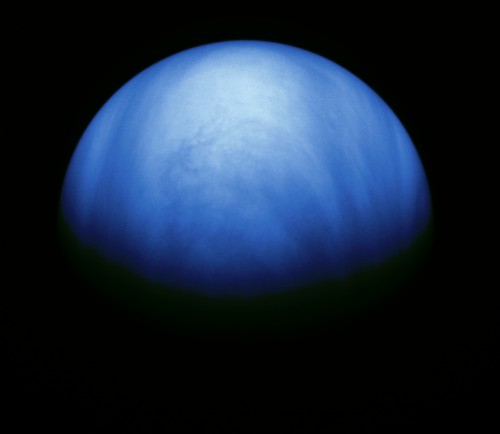
Thursday, December 20, 2012

Venus Upper Atmosphere Workshop on January 24

UPDATED: Details now available for remote attendees.

Are you a planetary scientist studying the Venusian atmosphere, or an engineer looking to build spacecraft or instrumentation that will further the study of our twin planet?  Then clear your calendar on January 24th, 2013.

NASA's Glenn Research Center, along with the Ohio Aerospace Institute, is sponsoring a Science and Technical Interchange Meeting (STIM) on the topic of Venus Upper Atmosphere Investigations.

The aim of this day-long set of meetings is to encourage the discussion of shared goals and priorities with regard to the study of the atmosphere of Venus by spacecraft.

According to the agenda, they hope to
  1. Foster a science discussion on goals, objectives, priorities, and significance of the Venus upper atmosphere and how Venus upper atmosphere science would contribute to overall exploration of Venus,
  2. discuss the desired measurements and measurement requirements to achieve potential Venus upper atmosphere science, and 
  3. discuss spacecraft concepts and technologies that could reach the Venus UA and collect and return the desired data.
If you cannot attend in person, they may be making arrangements for attending remotely-- I have a question out to one of the organizers and I'll update this post accordingly.

If you are lucky enough to be able to travel to the workshop and can arrive a day early, they are planning a tour of the nearly-completed NASA Glenn Extreme Environments Rig (GEER) on the afternoon of the 23rd. Once completed, the GEER will be able to accurately simulate any planetary environment in the solar system, including both the surface and the atmosphere of Venus. Read more about the GRC's Strategic Science work here.

If you are interested in attending, registration is required.

Thursday, November 29, 2012

First to Venus: Mariner II

While one Soviet Venera spacecraft certainly passed near Venus prior to August of 1962, it was not successful in transmitting any data back to Earth... so Mariner II gets the credit for being the first successful probe to visit Venus.

Launched on August 27, 1962, Mariner II carried the following experiments intended for use at Venus (other instruments also took measurements of interplanetary space while enroute):

  • Microwave radiometer - meant to determine the temperature of the planet's surface and details concerning the atmosphere.
  • Infrared radiometer - meant to determine the structure of the cloud layer, and temperature distributions at cloud altitudes.
  • Magnetometer - meant to detect Venus' magnetic field

Mariner II arrived at its encounter point on December 14, almost four months after launch.  Never intended to enter orbit or plunge into the Venusian clouds, the spacecraft began recording as much information as it could in the short time Venus would be in range (the spacecraft was moving at 6.743 km/s relative to Venus).  A special command from Earth placed Mariner II  in "encounter" mode, during which it transmitted all recorded data in real time.  It passe within 34,854 km, and seven hours later, Mariner II returned to cruise mode to continue on in a heliocentric orbit.  Communication was lost on January 3, 1963.

So what did we learn about Venus from Mariner II?
  • The 19-mm microwave radiometer indicated roughly equal temperatures on the light and dark sides of the planet:
    • dark side =  460° K
    • terminator = 570° K
    • light side =  400° K
  • Near Venus, there was no indication of a magnetic field or of appreciable change in the solar plasma flux or the charged particle flux.
  • The infrared radiometer measured atmospheric temperatures that are consistent with Earth-based observations (hovering around 230° K), and detected no significant difference between the light and dark sides of the planet.
  • Mass of Venus: 4.87 x 10^24 kg (0.81485 of Earth)
Mariner II was successful by any measure, and set the stage for continued exploration of the inner solar system.  It was followed to Venus by a number of probes from the U.S., the Soviet Union, and the European Space Agency.  More to come!


REFERENCES:

Chase, S.C.; Kaplan, L.D.; Neugebauer, G. (1963) "The Mariner 2 Infrared Radiometer Experiment, Journal of Geophysical Research 68 (22): 6157–6169. (http://ntrs.nasa.gov/archive/nasa/casi.ntrs.nasa.gov/19640006050_1964006050.pdf)

NASA, Mariner-Venus 1962: Final Project Report, NASA SP-59, Washington, 1965 (http://ntrs.nasa.gov/archive/nasa/casi.ntrs.nasa.gov/19660005413_1966005413.pdf)

National Space Science Data Center: Mariner II. NASA web site (http://nssdc.gsfc.nasa.gov/nmc/spacecraftDisplay.do?id=1962-041A)

Sonett, C. P. (1963). "A summary review of the scientific findings of the mariner venus mission." Space Science Reviews, 2(6), 751-777.

Tuesday, November 6, 2012

AcWriMo 2012 - My Commitment

Have you read about AcWriMo?  Yep, its a sort of National Novel Writing Month (NaNoWriMo) for academic writing.  I've decided to participate, and yes, I'm a little late to the game (It's already November 6).

This is where I make set a crazy goal: Complete a publishable (format and content, anyway) literature review of current thinking on astrobiological possibilities (past and present) for Venus by November 30.

Go Public: I just did with this blog post!

Strategy: Well, it's like writing anything, so there is a sequence for me:


  1. Collection: Find the published papers I will start with for the research.  This entails a lot of time with Google Scholar, RefWorks, and the SAO/NASA Astrophysics Data System.
  2. Reading.  just what it says, plus note-taking.
  3. Organization: Taking all of my notes and organizing them into the sections of the paper
  4. Writing.
There is a fair amount of rinse & repeat between steps 1 and 2, since good papers will lead me to others.  Even so, there is something to be written every day, almost from the beginning.

Discuss: I will.  I'll be posting here and on Twitter at @ElevenPointTwo.

What about Venus?

NASA Photo
Mars is getting a lot of attention lately.  Truth be told, Mars has been getting a lot attention for quite some time: landers, rovers, orbiters, and Elon Musk and President Obama want to send people there.  Mars One is creating a reality TV show to send contestants to the surface of Mars!

So what about Earth's "sister" planet?  Where's the love for Venus?  [This question is all the more ironic given that in Roman mythology, Venus was the goddess of love, beauty, sex, and all that.]

Well, I am not going to sit idly and do nothing.  I'm going to start giving Venus more of the attention it sorely deserves!  Here are some of my reasons:
  • Venus is right there every night (well, most nights)!  It's the second-brightest object in the night sky, and its phases can be observed with binoculars.
  • It is the closest-approaching planet to Earth (38 million kilometers at its closest)
  • It is roughly the same size and mass as Earth
  • It has an honest-to-goodness atmosphere
  • It possesses the most similar environment to Earth conditions in the solar system1
  • It may have harbored life in its early days
I've been interested in Venus for quite some time, and have always wanted to dig a little deeper into the subject.  Be careful what you wish for!  I'm currently taking a UND grad course in Astrobiology, and our final assignment is to write a literature review on an astrobiological subject.  I chose Venus, so it's going to be all Venus, all the time for me.

I'll do what I can to share interesting snippets here on the blog as I go, but I also plan to write some topical articles such as:
  • Robotic Missions to Venus: Past, Present
  • Robotic Missions to Venus: Proposed
  • The Case for Human Missions to Venus
  • Venus Facts You Should Know
Check back, I'll try to keep the material coming every week or so for a while.


Footnotes
1. This is not at the surface... it is about 50km up into the Venusian atmosphere.