Showing posts with label space. Show all posts

Tuesday, November 6, 2012

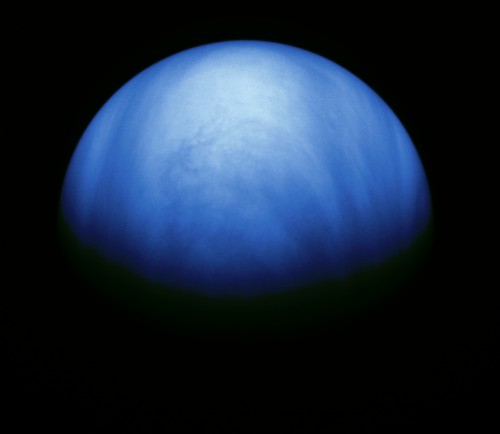
What about Venus?

NASA Photo
Mars is getting a lot of attention lately.  Truth be told, Mars has been getting a lot attention for quite some time: landers, rovers, orbiters, and Elon Musk and President Obama want to send people there.  Mars One is creating a reality TV show to send contestants to the surface of Mars!

So what about Earth's "sister" planet?  Where's the love for Venus?  [This question is all the more ironic given that in Roman mythology, Venus was the goddess of love, beauty, sex, and all that.]

Well, I am not going to sit idly and do nothing.  I'm going to start giving Venus more of the attention it sorely deserves!  Here are some of my reasons:
  • Venus is right there every night (well, most nights)!  It's the second-brightest object in the night sky, and its phases can be observed with binoculars.
  • It is the closest-approaching planet to Earth (38 million kilometers at its closest)
  • It is roughly the same size and mass as Earth
  • It has an honest-to-goodness atmosphere
  • It possesses the most similar environment to Earth conditions in the solar system1
  • It may have harbored life in its early days
I've been interested in Venus for quite some time, and have always wanted to dig a little deeper into the subject.  Be careful what you wish for!  I'm currently taking a UND grad course in Astrobiology, and our final assignment is to write a literature review on an astrobiological subject.  I chose Venus, so it's going to be all Venus, all the time for me.

I'll do what I can to share interesting snippets here on the blog as I go, but I also plan to write some topical articles such as:
  • Robotic Missions to Venus: Past, Present
  • Robotic Missions to Venus: Proposed
  • The Case for Human Missions to Venus
  • Venus Facts You Should Know
Check back, I'll try to keep the material coming every week or so for a while.


Footnotes
1. This is not at the surface... it is about 50km up into the Venusian atmosphere.

Friday, September 9, 2011

Is ATK the Newest Member of the CCDev Club?

Artist's Concept of
Liberty Launcher (ATK)
Next Tuesday, NASA and Alliant Techsystems (ATK) will jointly announce an agreement that could "accelerate the availability of U.S. commercial crew transportation capabilities."  It will not be carried live on NASA Television.

In the wake of the Russia's grounding of Soyuz launchers (effectively catching the U.S. manned space program with their pants down), the urgency to find alternatives is growing.

In April, ATK failed to receive CCDev-2 funds for the development of its Liberty launch vehicle. Undeterred, they decided to continue development of Liberty as a human-rated launcher in anticipation of future business with NASA (see SpaceFlightNow article).

I'm just speculating of course, but it seems highly likely that NASA and ATK have entered into a Space Act Agreement (SAA) to include the Liberty in the CCDev program.  Whether they will receive NASA funding, or work under an unfunded SAA (as ULA is doing in their efforts to man-rate the Atlas V, according to Aviation Week) is yet to be seen.

Even though the Liberty scored higher than the Atlas V in the CCDev-2 evaluations, none of the CCDev crew spacecraft competitors agreed to fly their craft atop the Liberty, according to Doug Messier at Parabolic Arc.  Are they nervous about putting people on top of a solid fuel booster?

I suspect NASA is trying to keep as many manned launch options as possible.  While no rocket is currently human-rated (even STS wasn't), The Falcon 9, Delta IV, Atlas V and now the Liberty are all viable options.  Increasing the competition may be the single biggest contributor to the hoped-for acceleration of the program.

UPDATE: I misread the press release-- the announcement wil not be carried on NASA TV.  Video highlights will be available afterward in NASA TV's Video File segment.

UPDATE 9/12: NASA has now decided to go ahead and broadcast the announcement live on NASA TV after all.  That's tomorrow (Tuesday) at 3:00pm EDT.

Monday, August 29, 2011

Catch-22 for Crew Transport to LEO

During his press conference this morning, ISS Program Manager Mike Suffredini said that if the Russians are unable to resume manned launches by mid-November, they will be forced to de-man the station no later than November 19th.

And while they are capable and ready to autonomously operate the ISS indefinitely, he made it clear that the absence of any crew would make it impossible for the SpaceX Dragon to dock with the station following its scheduled launch on November 30, 2011.

The interruption of LEO crew transport via Soyuz magnifies the need for alternatives (such as the Dragon), yet the test flights necessary to prove that the Dragon and its competition can successfully deliver supplies and people to the ISS cannot happen without a crew aboard the station.

On the other hand, if the problems that caused the loss of a Progress spacecraft last week are discovered and fixed such that human flights can continue to the ISS before she is de-manned, it will be more important than ever that SpaceX can successfully demonstrate the capabilities of the Dragon on November 30th.

Wednesday, August 24, 2011

Highlights of NASA News Conference: Loss of Progress 44

As reported in many news services, Russia lost contact with the Progress 44, and it failed to make orbit.

ISS Program Manager Mike Suffredini held a news conference at 12:00 Noon EDT, and passed along the following information:

Russia will be forming a commission to investigate, and the U.S. will be working with them to identify root cause of the failure.  This is the first Progress loss in the history of the ISS program.

There are implications to the ISS craft itself and the crews aboard.
  • The Soyuz booster used for the Progress launch is very similar to that used for crew launches, and the 3rd stage is identical, so this may impact the 22-September launch of the next 3-man crew, depending on the investigation.
  • Plenty of consumables to go a long time-- crews would reach the end of their time well before these are exhausted.
  •  The 3-person crew that is slated to return to Earth in September will reach 162 days in orbit by then.  The normal rotation period is 180 days, plus an additional 30 days of contingency.  This means they could stay on orbit another 45 days or so with no ill effects.  If the Soyuz crew launch is sufficiently delayed as a result of the ongoing investigation, Suffredini  said this crew will return to Earth and they can operate the station nominally with a total crew of 3 (but not much science will get done).
  • The currently higher orbit puts the ISS in a good position to tolerate delays in re-boost, although Suffredini pointed out that they have sufficient propellant onboard to proceed with the planned re-boost without the presence of the Progress.  the station can go for many months without re-supply.
Progress 44 was carrying 2.9 metric tons of non-unique supplies (easily replaceable): dry goods, water, fuel, and gasses.

When asked by a member of the press whether any of the planned commercial visits to the ISS could help with the delivery of supplies, Suffredini replied that even though NASA has an agreement to place 800 Kg on the SpaceX Dragon mission scheduled for November, he saw no reason to actually use the available capacity.  He also mentioned that Progress 45, currently scheduled for an October launch, could have its launch date moved up if needed.

Wednesday, August 3, 2011

Attending SpaceUp LA This Weekend

On Twitter, I stumbled onto the SpaceUp Unconference happening this weekend in Los Angeles.  I'm still trying to get my head around the "unconference" idea, but it definitely has my attention.  What's a SpaceUp?  It is a semi-structured, yet spontaneous meet-up of people with at least this one thing in common: A passion to see humanity venture out into space.  Given my recent re-birth as a space enthusiast and wannabe Space Scientist, it seemed obvious that I should attend.  I attempted to recruit a number of family and friends to join me, but it looks like its gonna be a road trip for one.

I'm a fairly outgoing person, but I'm still a bit intimidated by the way the whole thing works.  Apparently it would be entirely normal for me to slap together a 5-minute talk with a pre-made slide show loop and have my say!  I just don't have a topic yet, and the whole thing starts in two days.  I also will have the chance to kick ideas around with other attendees and propose session topics that would then be added to the "board."  I do have a couple of ideas for topics (e.g. "Old Folks in Space", "Let's find another use for the ISS after 2020"), so I'll need to make some notes for myself on these topics and be ready to speak up at the appropriate time.

It looks like a fun weekend.  I'll hit Interstate 10 after work on Friday and stop for the night in Palm Springs (Travelodge, here I come!).  Once I stagger out of my motel room and hit Denny's for coffee and a good Paleo breakfast, I'll have two hours of driving to get to the Columbia Memorial Space Center in Downey, CA.  The museum sounds great, and we un-conferencees will have full run of the place.  Lunch is provided on both days, and I'll even get a dandy t-shirt.

BTW, it is extra-good timing that my new MacBook Air arrived yesterday-- it is the perfect tool (along with my iPhone for tethering) for note-taking, surfing, and live-blogging during the unconference.

I'll be sure to blog and tweet whenever I can during this exciting two-day event, and maybe snap a photo or two as a bonus.

Tuesday, August 2, 2011

New course laid in

I am changing course.  I have spent the last seven years (and off and on a few before that) becoming an archaeologist.  I did this in my spare time, while raising two daughters and working a full-time job as an avionics software engineer.  I imagined that one day I would leave the engineering world behind, and become a more pure scientist by digging up, studying, and comparing ancient cultures.

Only a few weeks ago, I watched a live video feed of the Space Shuttle Atlantis lifting off for the last time.  Within 48 hours of this event, I had decided to make this course correction, setting a heading for a future in the Space industry.  I still had two weeks-worth of coursework remaining to complete my B.A. in Anthropology, and complete it I did.  But I am relegating my interest in archaeology to the "hobby" category (I'll never completely turn my back on it), and investing myself completely into the boyhood dream I abandoned so long ago: Space.

I have already enrolled at the University of North Dakota, whose M.S. in Space Studies looks fantastic.  I am taking the first course of the program (SpSt 501) as a non-degreed grad student, while putting together my application to the formal program.  This interdisciplinary program includes courses such as spacecraft systems engineering, radio astronomy, planetary geology, space mission design, politics of space, space law, and remote sensing.  For a kid who once wanted to work and live in space, this is about as good as it gets.

I currently work as a senior engineer at a small software firm specializing in embedded software for commercial, business, and private aircraft, as well as for military and space applications.  I'm hopeful that we will be able to expand our partnerships with customers working on both government- and privately-funded space projects, and that I can be a part of them.

I plan to use this blog to chronicle my journey, and to discuss space-related topics that interest me.  As a graduate student, I'll be expected to read more academic papers than I can count, and that should provide all the fodder I need to keep this blog humming.